If you want to understand whether a system is working, look at how it treats women — not in theory, not in policy language, but in reality. Who is safe. Who is economically stable. Who has access to opportunity, and who doesn’t.
Women sit at the fault line of almost every systemic issue we’re trying to solve, and right now, that fault line is widening. Women are disproportionately impacted by poverty, by housing instability, by violence. They are more likely to be responsible for children, more likely to have experienced trauma, more likely to fall through the cracks when systems fail — and once they fall, it’s exponentially harder to get back up.
None of that is new information. What should be new is our willingness to reckon with what it actually means. When a woman is economically unstable, that instability doesn’t stop with her. It extends to her children, her family, her broader community. Instability multiplies. And the opposite is equally true — when a woman gains real economic stability, not temporary support, it ripples outward in the same way. Households stabilize. Children stabilize. Communities stabilize. This is not a women’s issue. It’s a systems issue.
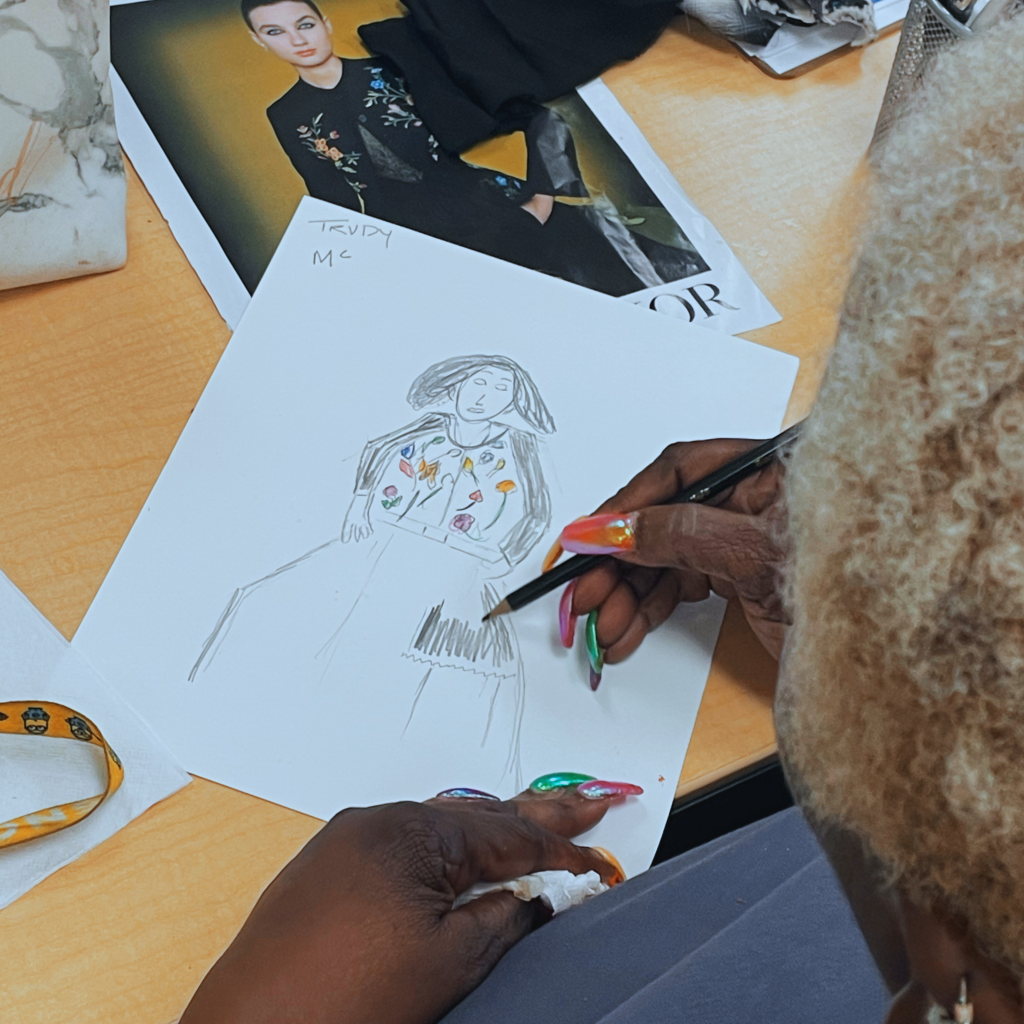
I saw this firsthand working with women at the Anne Douglas Center in Los Angeles — women in recovery, women who had been through more than most people could imagine. Many of them had never held a needle and thread before. When we started our first workshop, there was hesitation, skepticism, a kind of understandable distance. And then we started sewing, and something shifted. Not immediately, not dramatically, but steadily. We talked, we shared, we created something together, and over the course of a few weeks you could feel the room change.
The most important moment didn’t happen while we were teaching skills. It happened at the end, when the women saw the finished products they had made — Story Pillows, simple objects that carried their stories. For the first time, they weren’t receiving something. They were creating something tangible, something valuable. You could see it in their faces: a shift in how they saw themselves.
That’s the part we keep missing. We talk about services, resources, access — and all of that matters — but none of it replaces the experience of creating value. Of participating in the economy instead of being positioned outside of it. Of actually seeing yourself as capable. That’s where real change begins.
This is why workforce development, done right, is so powerful. Not as job placement or short-term training, but as a genuine pathway into economic agency — into ownership, into possibility. Make It Work LA was built around that idea: teaching women in recovery to sew using deadstock fabric from the garment district, not as an activity, but as a starting point. From there: design, production, entrepreneurship, and connection to a real market. Because the goal was never to keep people in programs. The goal was to connect them to an economy that recognizes their value.
There’s also something deeper here that’s harder to quantify but impossible to ignore. The qualities that have been historically undervalued in our economy — relational thinking, care, collaboration, adaptability — are the very qualities we need most right now. And women, particularly those who have navigated instability and survival, carry these capacities in profound ways. Not as theory. As lived experience.
We are trying to rebuild systems that are extractive, disconnected, and unsustainable, and we are doing it without fully engaging the people who are most equipped to help reshape them. That’s not just an oversight — it’s a strategic mistake. If we are serious about addressing homelessness and economic inequality, we have to start where the leverage is greatest. And that means investing in women — not as beneficiaries, but as builders. Because when women rise into economic stability, they don’t just change their own lives. They change the structure of the system around them. And right now, that’s exactly what we need.
Want to be part of this work?
We’re continuing this through our workshops and programs.