In 2015, my marriage ended—badly, abruptly, and totally.
I had never even imagined myself as someone who would get married. Divorce belonged, in my mind, to other people – unlucky people, distant people. And yet there I was, holding a young child, standing in the aftermath of something I hadn’t planned but had come to depend on as if it were permanent.
Motherhood had happened to me. Marriage had happened to me. And together they formed a kind of ground I didn’t know I had been searching for my entire life.
And then it was gone.
I moved to Tubac, Arizona with my son, back near my family. That year was the closest to death I ever felt. A total and excruciating dissolving of everything I thought I knew about myself – who I was, where I was going, what my life was. All of it fell away.
The desert, turns out, was the perfect place to fall apart – it’s dry and harsh and unforgiving – exactly what my life felt like – and yet it is always renewing. Things die, skins shed, and in their place something new and brilliant grows back. I started to take my cue from my surroundings – I, too, had to grow back, as something entirely new.
I needed to make something, with my hands, to pull something out of the formlessness I was living in.
So I started sewing.
What had always been a hobby became something else entirely: a ritual. A way to externalize what I couldn’t process internally. Fabric, thread, structure. Something that could hold shape when I couldn’t.
I made a jumpsuit. Because I love jumpsuits, and because I needed a new skin for my body, something I could step into that represented the new, best, version of me. Then, because I’m part goofball, part hopeless optimist, I added a small cape.
I called it a Supersuit. Why not?
Slightly absurd. Also completely necessary because it was an emblem of my survival. And because somewhere in the act of constructing it – cutting, stitching, assembling – I felt something shift. Not emotionally, at first, but structurally. Like I was building a version of myself that could re-enter the world. Not the woman I had been. Someone new. Someone I hadn’t met yet.
That was the moment I understood something I had never learned in any strategic plan or creative brief: Creation isn’t simply expression, it’s a way out.
Around that same time, a friend handed me Start Something That Matters by Blake Mycoskie. It cracked something open. If he could build a company out of a simple product and tie it to impact – if a shoe could carry that kind of intention – then maybe this strange, personal act of rebuilding myself wasn’t just mine.
Maybe it was a model for rebuilding what is broken in the world.
That idea became WUNZ Apparel in Action. I partnered with the Los Angeles Mission and started diving into how my Supersuit could help solve the crisis of homelessness. I had a LOT to learn.
But none of it started as a business idea. It started in collapse. More specifically – it started the moment I stopped trying to survive the wreckage, and started building something inside it.
We tend to think innovation comes from expertise. From people who are “qualified.” But I’m not a policy expert, or a politician, or a systems architect.
I’m an artist.
And I’ve come to believe that might actually be the point.
Because “qualified” often means trained to think inside the same systems that created the problem in the first place. And those systems, as we are witnessing daily, are breaking down.
We live in one of the wealthiest cities in the world, and thousands of people are sleeping on sidewalks. Millions of dollars are spent every year trying to solve homelessness – and the problem keeps getting worse.
At some point, we have to ask a harder question: What if the systems we keep trying to fix aren’t fixable? What if they were never designed to solve the problem at all?
This is where breakdown becomes the turning point. Because breakdown does something nothing else can do: it clears the ground. It strips away the illusion that what we were doing was working. It forces us – individually and collectively – to stop recycling the same ideas, the same approaches, the same assumptions.
And it puts us back in direct contact with something much more basic, much more powerful – our own resourcefulness.
What do we have?
What can we make?
Who is right in front of us?
What’s already here that we’re overlooking?
Working closely with people experiencing homelessness at the LA Mission, I saw the depth of the problem up close. I also saw something harder to admit: many well-intentioned systems, built for a different time, simply aren’t equipped for the scale or complexity we’re facing now.
What began to emerge for me as a solution didn’t fit inside those systems.
Real innovation, I came to understand, isn’t just about services – it’s about restoring a person’s sense of their own value. I saw it happen through creative work. As people I was working with made something – something tangible, something real – their perception of what they were capable of began to shift. And with it, their sense of contribution.
People who’ve been written out of the economic story need a way back in. Nothing changes until that happens.
Real change isn’t about giving people things. It’s about creating pathways for people to generate value – to participate, to build, to contribute.
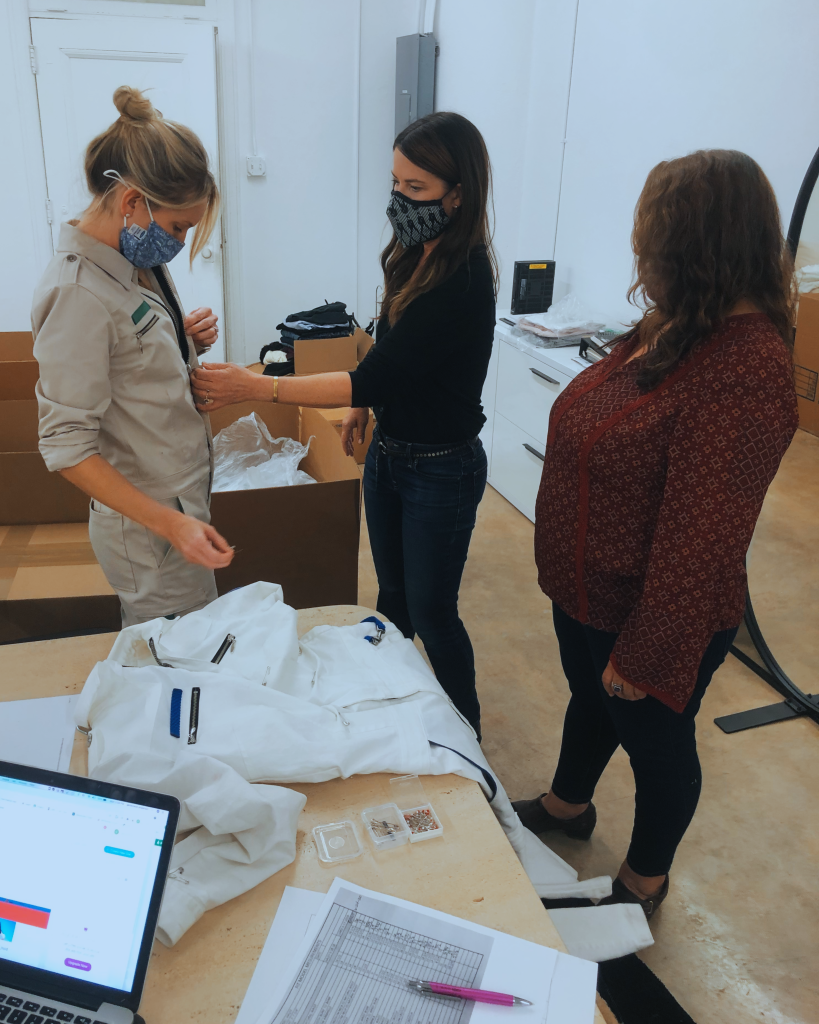
That insight became Make It Work LA, a workforce development program I created with partner Vanessa Watson, teaching at risk women sewing and entrepreneurship in the heart of Skid Row.
A workforce development program built around something incredibly simple:
Teaching women in recovery how to sew using deadstock fabric from the garment district, and creating products that can be sold into the existing economy – starting with hotels in downtown LA.
It’s scrappy, simple, and connected. And it works.
Because it’s not built on theory. It’s built on the same principle that brought me back to life in the desert: When things fall apart, you make something. And making things together, in community, is the most powerful of all.
We are living through a moment of massive breakdown – economically, socially, structurally.
It’s the end of one story, and the beginning of another. This is the clearing. The place where the old story stops making sense – and something new is trying to emerge.
But it’s not going to come from the same systems, the same institutions, the same thinking that got us here. It’s going to come from people who are willing to get a little scrappy. People who are willing to look at what’s already in front of them – and start building.
Because sometimes the best place to begin is the wreckage.
Want to be part of this work?
We’re continuing this through our workshops and programs.